I once took over a control room carrying an unusually high volume of admin and non-core tasks. A task analysis identified 264 individual tasks assigned to the control room. We ran them through a RACI process and allocated them accordingly. The majority were reassigned to other departments. The pushback was immediate. Other departments had never owned that work. Dispatch had always done it. The control room was seen as a clerical function, not an operational one.
Your Fleet Management System cost millions. The server room is climate-controlled. The in-cab displays are ruggedised. The algorithm processes billions of parameters per shift. And the person responsible for making it all work sits in a noisy office, fielding phone calls about timesheets, running on ten hours of screen time with no mandated break.
Harder Than Air Traffic Control
The NASA Task Load Index (NASA-TLX) is the global standard for quantifying cognitive workload. It has been used across every high-consequence industry from aviation to intensive care. A field study of 63 mining control room operators used the NASA-TLX alongside Cognitive Task Analysis to measure what dispatchers actually experience during a shift.
The results should concern every mining executive who has ever questioned the headcount in the control room.
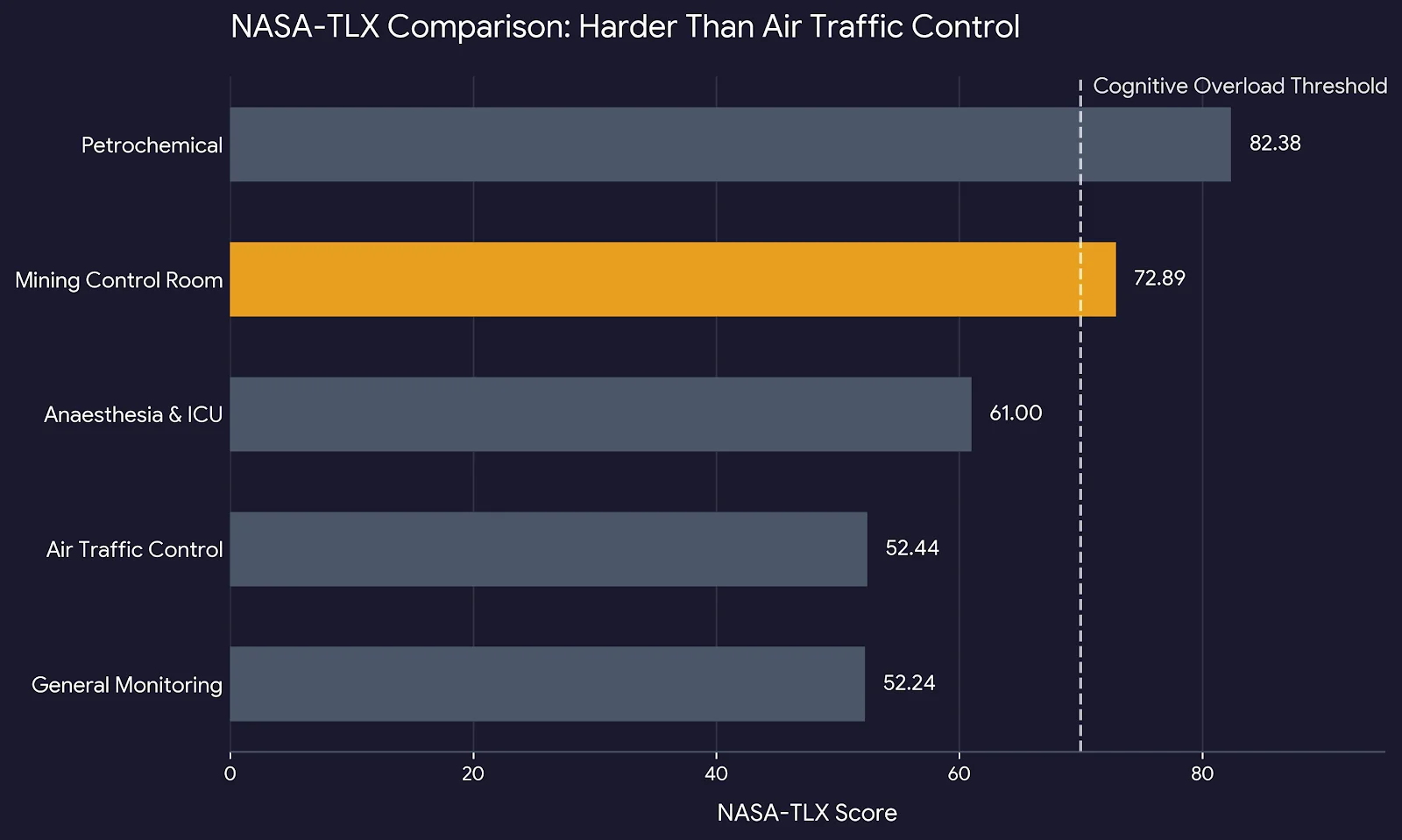
Mining dispatchers scored 72.89 out of 100. Air traffic controllers scored 52.44 (a median drawn from a meta-analysis of 24 ATC workload studies reported in FAA technical literature in 2007, not a single definitive benchmark). The dispatcher managing your haul fleet is operating under a higher measured cognitive load than the person separating aircraft on final approach.
The same study measured total cognitive demand across twelve factors. The mean score was 6.60 out of 7.00. That is not “busy.” That is the physiological ceiling.
The two factors that drove the score highest were memory and defect detection. In practical terms, that means remembering what the system is doing across dozens of active trucks while simultaneously spotting when something is wrong. When a dispatcher has no technical support and is forced to mentally track sensor inaccuracies, ghost trucks, or GPS drift, their working memory fills completely. Strategic fleet management stops. Reactive firefighting begins.
Research on human operators working alongside complex decision-support systems established a critical cognitive ceiling: approximately 250 dispatching decisions per hour. Beyond that, operators enter cognitive overload and begin making erratic, suboptimal choices. The FMS might process billions of variables, but it surfaces exceptions, alarms, and routing conflicts that require human resolution. On a large fleet with multiple shovels, blend constraints, and active disruptions, 250 decisions per hour is not a generous ceiling. It is a wall that most dispatchers hit well before mid-shift.
The Broom Cupboard Problem: Why Mining Treats Dispatch as a Clerical Role
If cognitive overload were the only issue, the fix would be straightforward: staff appropriately and protect the dispatcher’s bandwidth. The deeper problem is that most operations have no intention of doing either, because they do not see the control room as a strategic function. They see it as a clerical one.
The AusIMM has written directly about this. In too many operations, mine control exists solely to capture data for the mine owner’s reporting: grade control logs, planning reconciliation, shift delivery documentation. The dispatcher is not managing the fleet. They are populating spreadsheets.
The industry even has a name for the worst version of this: the “broom cupboard.” A tiny room. An untrained operator trying to run a fleet off a single screen and a handheld radio. No FMS optimisation. No strategic oversight. Just data entry and firefighting.
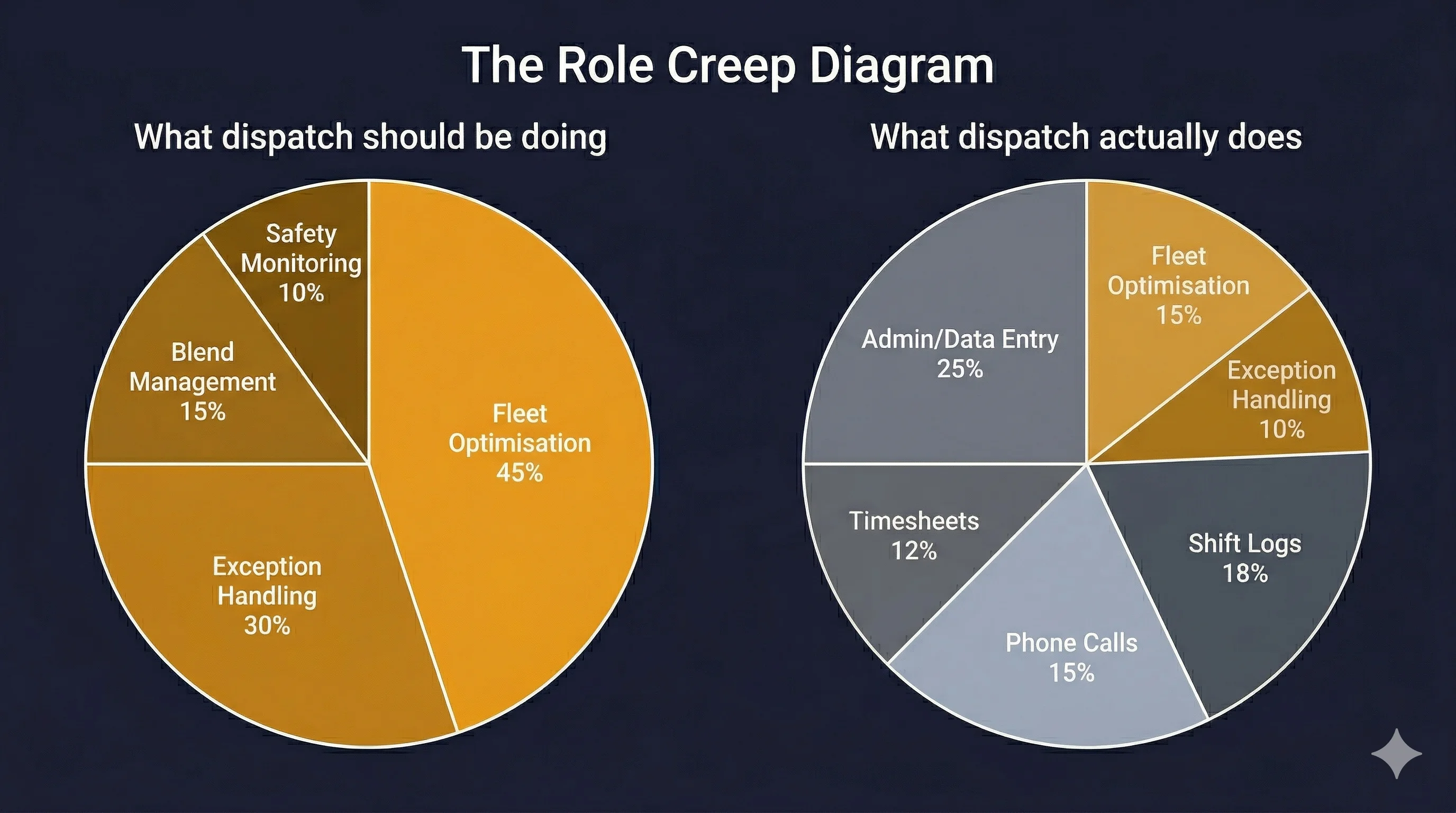
But even well-resourced sites fall into the same trap through a slower, more insidious mechanism: role creep. Because the dispatcher sits at the communication nexus of the mine, they become the default for every administrative task that nobody else wants to own. Timesheets. Shift logs. Phone calls from the Nurse reminding Dispatch that Jimmy has an appointment (usually in the most productive part of the day). Radio calls from operators asking about crib break schedules. Supervisors wanting Dispatch to organize more overtimers for tomorrow.
Each task seems small. None of them, individually, would overwhelm a competent operator. But they accumulate. And the cost of each one is not the minutes it consumes. It is the cognitive disruption it causes.
What Happens to a Brain on Hour Ten
When a dispatcher looks away from the FMS to answer a phone call, they are not taking a break. EEG research on multi-task switching confirms that the brain works harder during the transition between tasks than it does during either task individually. Answering the phone is not a rest from monitoring. It is an additional cognitive spike on top of an already maxed-out workload.
Early in a shift, people can compensate. They slow down slightly to maintain accuracy. But mining shifts are twelve hours. Research on mining equipment operators under fatigue and task interruption conditions shows that as fatigue accumulates, that compensation fails. Accuracy drops. Recovery time after each interruption gets longer. By hour ten, the dispatcher is not choosing to be less effective. Their brain is physically unable to maintain the same level of performance it delivered at hour two.
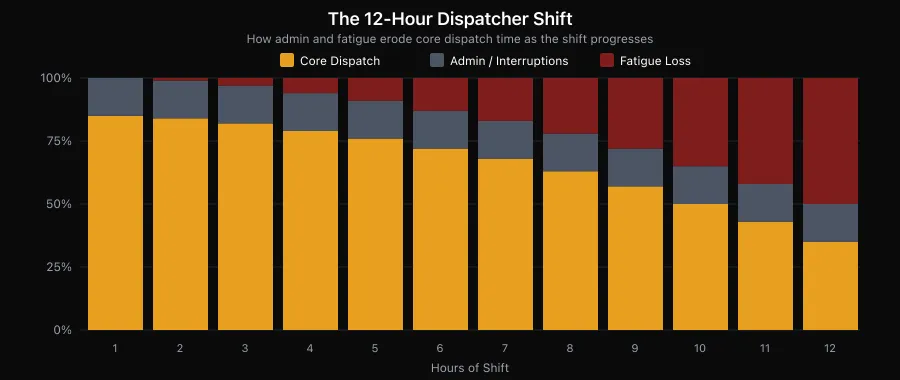
The practical consequence is what every experienced dispatcher already knows. Under sustained load and fatigue, you stop looking for optimisation opportunities. You stop shaving seconds off cycle times. You stop proactively rebalancing when a shovel is trending toward over-trucked. You wait for the alarm. You react. The FMS becomes a monitoring tool instead of an optimisation engine. And nobody in management notices, because the trucks are still moving.
FMS Trust Collapse: Why Dispatchers Revert to Manual Lock-On
Under-resourcing creates a second problem that is just as damaging: system distrust.
When an FMS produces frequent false alarms, routes trucks to congested shovels because the road network has not been updated, or fails to accurately read payload telemetry, the dispatcher’s workload spikes. They have to work out whether the system is wrong or reality has changed. Without dedicated FMS technical support on site, every unresolved glitch erodes that trust a little further.
Research on automation trust puts a number on the threshold. Once false alarm rates hit 60%, operators stop following the system’s advice altogether. That threshold was established in automotive collision warning research and is applied here by analogy; no equivalent mining-specific false alarm compliance study exists in the published literature. In a mining context, that means the dispatcher stops accepting the algorithm’s truck assignments. They revert to manual lock-on, rigidly assigning specific trucks to specific shovels and ignoring real-time queue lengths, fuel levels, and payload requirements.
Manual lock-on is the quiet killer of FMS value. The consequences are well understood by anyone who has worked a dispatch chair: bunching, blend failure, inflated empty travel, and the complete negation of dynamic optimisation. The multi-million-dollar FMS becomes a glorified GPS tracker.
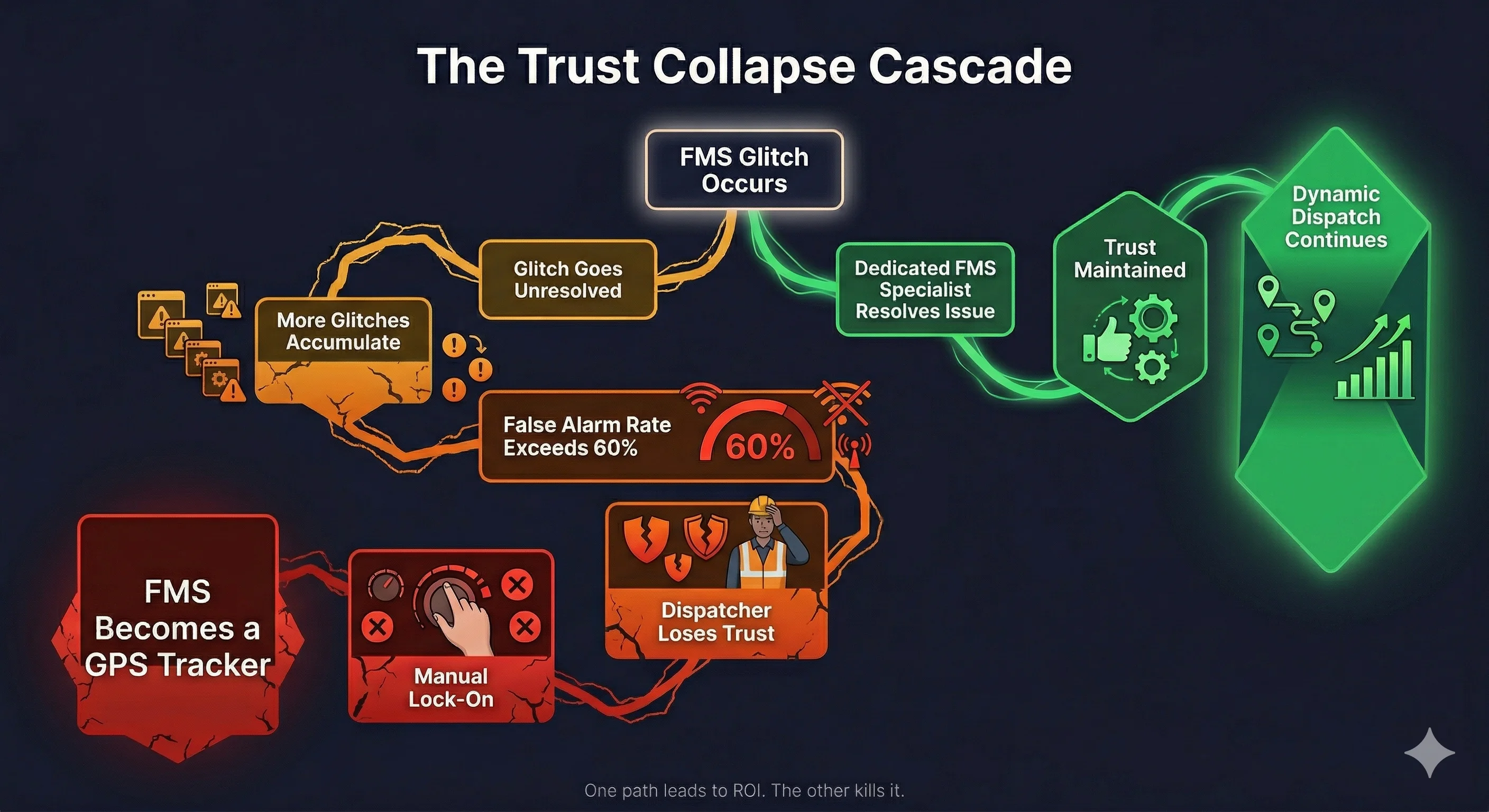
The root cause is almost never the algorithm. It is the absence of dedicated FMS specialists who keep the system calibrated to reality. Caterpillar deploys “MineStar Performance Managers” and “Application Specialists” for exactly this reason. Modular Mining (Komatsu) runs a Performance Assurance program that assigns dedicated experts to review DISPATCH configurations and recalibrate settings as the pit evolves. Without this layer of support, the system drifts out of sync with the mine’s daily reality. The dispatcher notices. The dispatcher stops trusting. The dispatcher overrides. And the FMS investment dies quietly.
These vendor roles are scoped to the operation and optimisation of their own system. They will train dispatchers on the software and recalibrate configurations as the pit evolves, but they will not restructure the dispatch function, strip out admin tasks, fix staffing ratios, or redesign the control room. Those are operational decisions that sit with the mining company.
The Numbers Nobody Wants to Hear
The cost of a properly resourced control room is easily calculated. Salaries. Training. A dedicated FMS specialist. Ergonomic upgrades. It is a line item that procurement can quantify and management can challenge.
The cost of an under-resourced control room is hidden in production shortfalls that never get attributed to the right cause.
Here is what properly trained, properly resourced dispatch is actually worth, drawn from published case studies:
Copper Mountain, British Columbia. Dispatchers were trained and resourced to actively monitor truck payloads in real time. By catching underloading events where material had settled during loading and directing operators to add approximately 10 extra tonnes per load, they achieved productivity gains equivalent to adding an entirely new truck to a 21-truck fleet. The avoided capital expenditure: $4 million for the truck they did not need to buy, plus $2 million per year in operating costs they did not need to incur.
Modular Mining (Komatsu) Performance Assurance engagement. A site brought in dedicated experts to recalibrate DISPATCH configurations and provide targeted dispatcher training. Over seven months, ton-miles per hour increased 29%, from 958 to 1,238. No new equipment. No new roads. Just people who knew how to use the system properly, with the time and support to actually do it. That 29% came from the vendor tuning their own system and training staff to use it properly, without addressing role creep, admin burden, staffing, or the control room environment. The vendor fixed their half of the problem, and the gains were still that large.
Fleet optimisation modelling. Published research on multi-objective dispatching models demonstrates that properly optimised FMS operations can decrease required fleet sizes by 22.2% while maintaining equivalent production. Advanced models show production improvements of 36% to 50% over standard, uncalibrated operations. These are modelling results and should be read as upper bounds. The real-world gains at Copper Mountain and from the Performance Assurance engagement confirm that material improvement is achievable with relatively modest intervention.
A 40-truck fleet running at $400 per hour per unit across 8,750 operating hours per year with a 15% productivity gap represents roughly $21 million in unrealised value. Substitute your own numbers.
The dispatcher who catches an underloading trend across ten trucks saves more in a single shift than their annual salary. The FMS specialist who recalibrates the algorithm after a pit pushback recovers production that would otherwise bleed quietly for months. The second dispatcher on night shift who prevents the primary operator from hitting cognitive overload at 3am does not show up in any cost-benefit analysis, but their absence shows up in every production reconciliation.
What Other Control Industries Do Differently
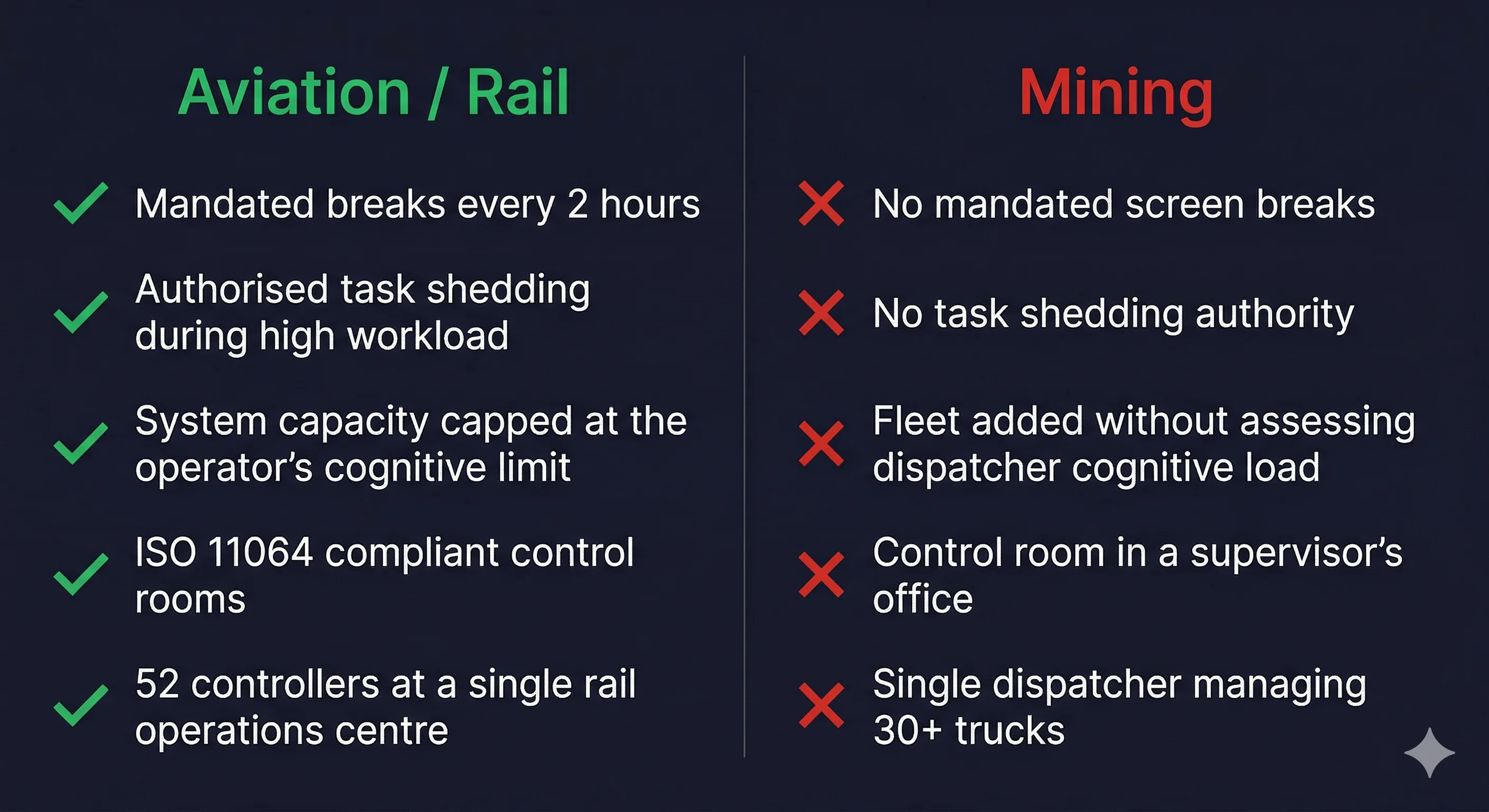
Aviation, rail, and petrochemical processing all operate high-consequence control rooms with significant automation. None of them treat the human operator as an afterthought.
Air Traffic Control. The FAA mandates 10 hours of rest between shifts and 12 hours after midnight shifts. Controllers receive mandatory breaks from the screen at least every two hours. Crucially, the FAA explicitly authorises “task shedding” during high-workload periods. Controllers are legally permitted to abandon secondary tasks when their primary safety workload demands it. Non-core services are only required “when the work situation permits.”
In mining, dispatchers are rarely given that authority. The timesheets still need to be done. The shift log still needs to be completed. The phone still needs to be answered. Regardless of whether three shovels are hanging and the crusher feed is off-blend.
Airport capacity models. Eurocontrol explicitly bounds airport capacity based on the controller’s cognitive workload threshold. If traffic volume exceeds what the controller can safely manage, the system rejects further volume. Capacity is capped at the human limit, not the infrastructure limit. Open-pit mines do the opposite. They add trucks, shovels, and complex pit geometries to the dispatcher’s screen without ever evaluating whether the dispatcher can cognitively process the additional load.
Rail operations. Metro-North’s Operations Control Centre employs 52 rail traffic controllers to manage its network. Automation changed the nature of their work. It did not reduce the headcount. Mining consistently draws the opposite conclusion.
How to Fix an Under-Resourced Mining Control Room
The gap between current practice and what the evidence demands is large, but the individual changes are not complicated.
Strip the admin
Timesheets, shift logs, and phone calls about medical appointments are not dispatch functions. They need to go somewhere else. If the control room is the only place these tasks can live, you are admitting that you have not resourced the rest of the operation properly. A dispatcher who spends 20% of their cognitive bandwidth on admin is delivering at minimum 20% less FMS optimisation. The admin is not free. It costs whatever that 20% of fleet productivity is worth. The golden rule: Dispatch manages Equipment, Supervisors manage people.
Fund dedicated FMS support
The system needs someone who keeps it calibrated. Road networks change. Pit designs evolve. New dump locations come online. If nobody is updating the FMS to reflect reality, the algorithm degrades, dispatchers lose trust, and manual overrides take over. Caterpillar and Modular Mining both build dedicated support roles into their service models because they know their systems fail without them. If your site does not have this role, your FMS is almost certainly underperforming.
Scale staffing with complexity, not headcount ratios
Adding four trucks to the fleet does not add four trucks worth of work to the dispatcher’s screen. It adds disproportionately more routing conflicts, queuing scenarios, and blend interactions. Queuing models show that when fleet sizes push arrival rates past shovel capacity, queuing times compound rapidly. The staffing plan needs to reflect the non-linear relationship between fleet size and dispatcher workload.
Give dispatchers the authority to shed
When three shovels are hanging and the crusher is off-blend, the dispatcher needs to be able to ignore the phone and skip the shift log until the situation stabilises. This is not a cultural preference. It is what every other high-consequence control industry does. Formalise it. Write it into the role description. Make it policy.
Build the room properly
ISO 11064, the international standard for control centre design, specifies requirements for acoustic isolation, localised climate control, visual shielding, and ergonomic workstation layouts. It has existed for decades. Mining largely ignores it. A dispatcher in a noisy office with a single monitor and constant foot traffic is starting every shift with a cognitive handicap that no amount of training will overcome.
The Dispatch Ceiling defines the hard limit on what dispatch can recover from the production losses created by planning and supervision failures. This post makes a different but related argument: that the person operating below that ceiling is being set up to fail.
The broader Integrated Operations movement is pushing mines toward centralised, cross-functional control rooms where dispatch, geology, processing, and maintenance coordinate in real time. That vision only works if the people in the room have the bandwidth, the authority, and the environment to actually make decisions. When controllers are relegated to clerical roles, logging truck movements, recording delays, and filling in spreadsheets, the most sophisticated IOC in the world becomes an expensive overhead with no operational leverage.
Right now, across too many operations, the person running the fleet is overloaded, under-supported, buried in admin, and working in a room that was designed for filing, not fleet optimisation. This article addresses open-pit dispatch, but the same patterns exist in underground operations, often with less visibility and fewer resources. The fix is a staffing and resourcing decision, and it is straightforward enough to build a business case around.